
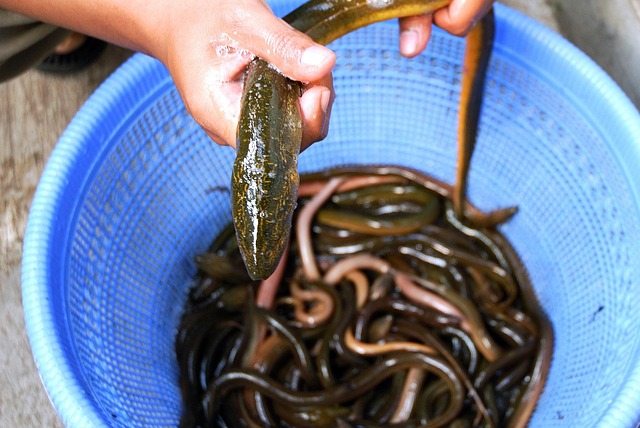
Hal lived a simple life. He lived in his mother’s garage and grew food in a garden and angled for game in the brackish, man-made estuary on Holland Street. He loved to fish. He had to fish. You could usually find him standing on the old, crumbling cobblestone dams with his reel, waiting for the eels to bite. He liked to fish in the rain and at night and he fished every day. He was known among some of the smaller neighborhood kids as, That Guy that Fishes for Snakes but they were actually eels. The kids just never got close enough to see the truth. People were not always eager to approach Hal.
Hal cut his own bait. He used sections of nightcrawlers and insect larvae and bits of roadkill. Eels are not picky eaters. They are bottom feeders. Hal saw himself as a bottom feeder too, but not in a bad way.
He had quit his job at Eli Whooten, where he stuffed junk-mail into envelopes by machine. He’d worked there for three years. He was glad to be rid of the job. “I hated that place and folks hated what I did,” was how he put it. “Nobody likes junk-mail. Nobody but nobody.” Hal talked like that.
His mother didn’t work either but she dated a man who had money to give her. The man smuggled fireworks and slugs and sold hashish and raised angry pit-bulls for the fight ring. He also made homemade porn that involved saliva and women’s feet. He had a lot of irons in the fire. In the back of Hal’s mother’s house were three kennels and a big wooden wheel to run the dogs. It was like a hamster-wheel for bigger animals.
They kept the dogs nervous and agitated by throwing rocks on the corrugated aluminum roofs of the kennels. There was a lot of banging and barking in Hal’s world.
Hal had a green thumb. He grew vegetables; he grew pot. His vegetable garden was small and yellow. He cultivated yellow pear tomatoes, summer squash, yellow beans, sunflowers, yellow peppers and eggplant – a strange black pupil in a golden eye.
Behind a stand of red pine trees he tended his pot crop. It thrived and what he didn’t smoke, he sold, using the money to buy Pabst beer and sundries.
American eels are catadromous, that is, they spawn in the sea but spend most of their lives in fresh water. Three small, sluggish rivers deposited warm water into the Holland Street estuary, which held it in a series of stone channels that eventually reached the sea. The Holland Street estuary was heavily polluted. Hal said he could smell the heavy metals, radionuclides, polychlorinated biphenyls and hydrocarbons there. That was why he preferred to fish when it rained – it diluted the reek. He held a theory that by ingesting the eels, he was immunizing himself against cancer. He said that sometimes, after a big eel meal, his stomach glowed in the dark, but nobody had ever seen this phenomenon and not many believed him. Hal was given to tall tales. Not that he lied. He really believed the things he said. He’d still believed in the Easter Bunny at ten years old. He was really just a big kid.
You could follow the barrier islands to a salt marsh and the Atlantic beyond, but Hal stuck to the estuary. He had a small, six-foot spinning rod with six-pound test that he’d inherited from his dead father. The eels were sometimes strong enough to bend his Cricket Aberdeen hooks, so deep-sea fishing was not an option for him. Not that he would have gone anyway.
Hal’s dad had died from a healthy dose of prostate cancer when Hal was three. He lingered and shriveled for nine months before he stopped. Hal never really got over his father’s death. It stayed with him forever.
Hal sometimes caught so many eels, he’d carry them home in a bucket and drop them live into a blue kiddie pool behind his mom’s garage. Once, he had as many as thirteen eels squirming in the pool at once and could eat at his leisure.
He’d clean the eels by tying a string behind the gills, cutting out a circle of skin, and then peeling the rest off with pliers. “I’m living off the fat of the land,” he’d say. He cut off the heads and used the entrails as more bait. “Eels aren’t opposed to cannibalism,” he said. “They got no scruples about that.”
He fried the eels on a Sterno stove with butter and pepper. Hal had hypertension so he avoided salt whenever possible. “The onliest thing with salt I can’t refuse is pork rinds,” he declared once.
Hal offered his mother eels to eat but she thought they were disgusting and told him, “No thanks, I’d rather eat snot,” which Hal thought was insulting. He also thought it was unfair that he offered her food but she offered him none. It was bad enough she’d turned his bedroom into a huge closet and made him live in the garage.
Most of the garage was taken up with Hal’s dead father’s antique bottle collection and Hal was ever-eager to discuss what made the bottles valuable. There were hundreds of them and Hal would demonstrate how they didn’t have seams or screw-tops and he’d point out all the air bubbles floating in the glass. Some kids thought it was funny to call him, “Bottle,” as in, “Hey, Bottle! What’s your oldest bottle?” Hal wasn’t offended by this and saw the greeting as an invitation to talk about bottles.
Once, Hal’s mother’s boyfriend Luis came up from Florida and gave Hal a baby alligator. It was a popular attraction among the neighborhood kids. They used to hang around Hal’s garage and watch him feed it. He fed it leftover eel. He gave the alligator several names but none stuck. And then one day it was gone. Hal said it had died and that he’d used it as bait. “It’s only fair,” he said. “The gator ate the eels and the eels ate him. Then I ate the eels.”
But a myth grew that Hal had freed the reptile in the Holland Street estuary. He insisted it wasn’t true, that he wouldn’t be that irresponsible, but people preferred the legend to Hal’s truth and kids hung around the water all that summer, looking for the alligator, speculating about how large it may have grown.
“Eels like to nibble,” Hal used to say. “But they’ll swallow your hook too. It takes skill to catch an eel. They have small mouths. They can migrate a thousand miles. They’re real slippery, so it’s best to put some sand or grit on your hands when you take them off the hook. Gives you more of a secure grip.”
Hal was proud of his skill with eels and had every right to be.
Hal was okay.
Discover more from Crumbling Asphalt
Subscribe to get the latest posts sent to your email.
 Crumbling Asphalt